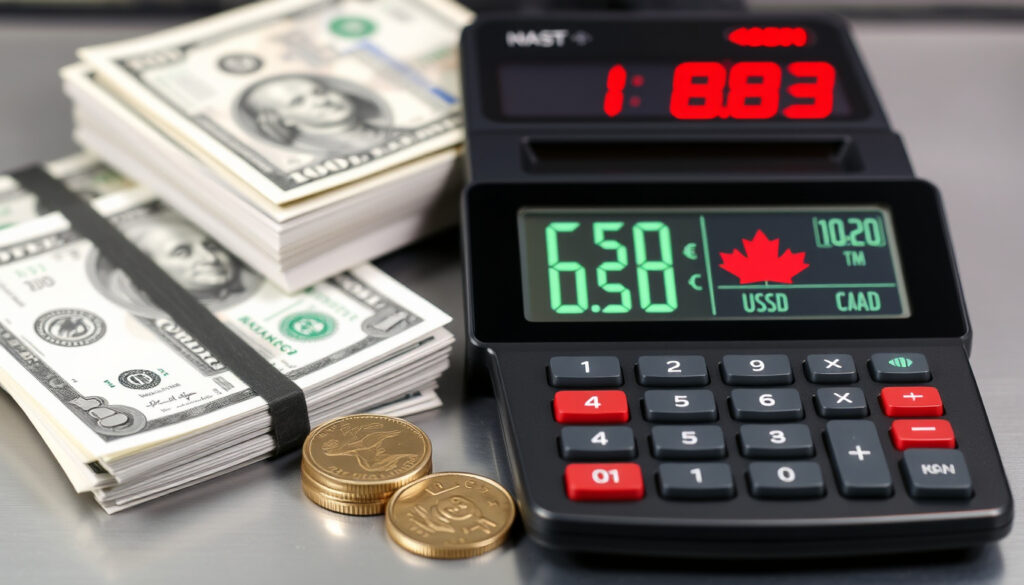
6 USD to CAD – Current Rate and Best Conversion Tips
For anyone needing to convert 6 US dollars to Canadian dollars, the current exchange rate places that amount at roughly 8.26 to 8.35 CAD, depending on the provider. The USD/CAD pair remains one of the most traded currency combinations globally, and even small amounts like 6 USD can see meaningful variation between services. Understanding where rates come from, which providers offer the most favorable terms, and what drives daily movements helps ensure you get the most accurate conversion possible.
Currency exchange rates fluctuate constantly due to economic data releases, central bank decisions, and market sentiment. For transactions involving modest sums, the difference between providers might seem minimal, but fees and spreads can erode value quickly. This guide breaks down the current rate environment, historical context, and practical steps for converting USD to CAD efficiently.
What Is 6 USD to CAD Right Now?
At present, 6 US dollars converts to approximately 8.35 CAD when using the mid-market rate of 1.393 CAD per USD. However, rates vary across providers. Xe.com shows the pair at 1.39114 (up from the previous session), meaning 6 USD equals roughly 8.35 CAD on that platform. TradingView data indicates the rate at 1.37579, reflecting a 0.23% decline over the past 24 hours. Investing.com recorded a previous close of 1.3792 with a current rate near 1.3768.
The spread between the lowest and highest rates observed across platforms represents the bid-ask difference and provider margins. For small conversions, these variations can account for several cents per transaction, making provider selection important even at this scale.
- Mid-market benchmark: Wise currently offers 1.393 CAD per USD, widely regarded as the most transparent reference rate.
- Daily volatility: The pair traded between 1.37459 and 1.3801 on IG’s platform, indicating modest intraday swings.
- Direction signal: TradingView analysts note bearish reversal potential, with support near 1.4238 if the downward trend continues.
- Interest rate differential: The US Federal Reserve holds rates at 3.75%, while the Bank of Canada sits at 2.25%, creating persistent pressure on the pair.
- Oil correlation: Canada exports significant crude oil, meaning rising oil prices often strengthen the Canadian dollar against its US counterpart.
- Provider-specific fees: Banks and exchange counters typically add 1–5% to the mid-market rate, while online services like Wise display more competitive pricing.
- Large-trade rates: RBC Bank provides interbank rates for transactions starting at US$5 million, according to their published guidelines.
| Metric | Value | Source |
|---|---|---|
| Xe.com rate | 1.39114 CAD/USD | Xe.com |
| Wise mid-market | 1.393 CAD/USD | Wise |
| TradingView rate | 1.37579 CAD/USD | TradingView |
| Investing.com rate | 1.3768 CAD/USD | Investing.com |
| IG daily high | 1.3801 CAD/USD | IG |
| IG daily low | 1.37459 CAD/USD | IG |
| 6 USD at Wise rate | 8.358 CAD | Wise |
| BoC policy rate | 2.25% | Bank of Canada |
Current USD to CAD Exchange Rate
The USD/CAD exchange rate reflects the value of the US dollar expressed in Canadian dollars. At the time of this writing, rates cluster around the 1.37–1.39 range across major platforms. The pair sometimes moves more than 0.5% in a single session, driven by economic releases from both countries, changes in commodity markets, and shifts in risk appetite.
Comparing Rates Across Platforms
Each data source employs slightly different methodologies for rate collection. Xe.com aggregates interbank feeds and updates continuously, resulting in rates that may differ by fractions of a cent from competitors. Wise positions its mid-market rate as a transparent benchmark without hidden markups, making it popular among cost-conscious converters.
Exchange rates are indicative and vary by transaction type, payment method, and provider fees. Always confirm the exact rate offered at the time of your transaction.
TradingView tracks the pair using real-time forex data with technical overlays. Their charts show support and resistance levels that traders monitor for potential reversals. Currently, the pair shows resistance near 1.4485, with support identified around 1.4238 according to TradingView technical analysis.
Why Rates Differ Between Sources
The spread exists because providers build margins into their quoted rates. Banks and currency exchange kiosks typically offer rates 1–3% worse than the mid-market benchmark. Peer-to-peer platforms and fintech services like Wise often come closer to the interbank rate, though small transaction fees may still apply. For converting 6 USD, the practical difference between the best and worst available rates could amount to a few Canadian cents.
How to Convert USD to CAD
Converting US dollars to Canadian dollars involves selecting a provider, initiating the transfer, and receiving CAD in your account or as cash. The method you choose affects both the exchange rate received and the speed of the transaction.
Online Currency Converters
Platforms such as Xe.com, Wise, and OANDA provide instant conversions with real-time rates. Simply enter the amount in USD, and the tool calculates the CAD equivalent based on current market pricing. These converters work well for informational purposes, though the rates shown may not apply when actually executing a transaction.
Bank Transfers and Exchanges
Traditional banks offer currency exchange through branch visits or online banking platforms. RBC Bank, for example, enables free instant CAD↔USD exchanges between accounts held at RBC, using interbank rates for non-cash transactions. Major US banks may charge higher fees or apply less favorable spreads compared to specialized forex providers.
For small conversions like 6 USD, online providers with low or no fixed fees typically offer better value than banks. Check whether your bank charges a flat fee per transaction, as this can outweigh the benefit of a slightly better rate.
Reference Conversion Table
Based on Wise’s mid-market rate of 1.393 CAD per USD, the following values apply for common amounts:
| Amount (USD) | CAD Equivalent |
|---|---|
| 1 | 1.39 CAD |
| 5 | 6.96 CAD |
| 6 | 8.35 CAD |
| 10 | 13.93 CAD |
| 50 | 69.63 CAD |
| 100 | 139.25 CAD |
These figures serve as benchmarks. Actual amounts received may differ slightly depending on the provider and any applicable transaction fees.
Why Does the USD/CAD Rate Change?
The USD/CAD exchange rate shifts in response to economic fundamentals, market dynamics, and geopolitical developments. Understanding these drivers helps explain why the rate fluctuates and how to interpret short-term movements.
Interest Rate Differentials
Central bank policy rates exert significant influence over currency values. The US Federal Reserve’s current rate of 3.75% exceeds the Bank of Canada’s 2.25%, which generally supports the US dollar against the Canadian dollar. When this differential widens, capital flows toward USD-denominated assets, increasing demand for dollars and pushing the rate higher.
Oil Price Movements
Canada ranks among the world’s largest oil exporters, and the Canadian dollar often behaves as a commodity currency. When crude oil prices rise, Canada’s trade balance improves, strengthening demand for CAD. Conversely, declining oil prices can weaken the Canadian dollar, widening the USD/CAD spread.
Economic Data Releases
Monthly reports on employment, inflation, gross domestic product, and trade balances from both the United States and Canada move markets when they deviate from expectations. Positive surprises for US data tend to boost the dollar, while strong Canadian figures support the loonie. For more context on rate dynamics, review our guide to the US Canada exchange rate.
Market Sentiment and Risk Appetite
During periods of heightened risk aversion, investors seek safe-haven assets like the US dollar, pushing USD/CAD upward. When risk appetite returns, commodity-linked currencies such as the Canadian dollar tend to appreciate. Daily fluctuations of 0.2–0.5% often reflect these sentiment shifts rather than fundamental changes.
Technical analysis from TradingView suggests possible bearish reversal potential for USD/CAD, targeting support near 1.4238 from current levels. However, forex forecasts involve significant uncertainty, and short-term predictions frequently fail to materialize.
Recent USD/CAD Performance Timeline
Tracking the pair’s movement over different time horizons provides context for current rates and helps identify trends.
- Current session: USD/CAD trading near 1.3768–1.39114, with minor intraday fluctuations across platforms.
- Past 24 hours: TradingView records a 0.23% decline from the previous close, suggesting modest loonie appreciation.
- Daily range: IG data shows the pair moving between 1.37459 and 1.3801 during the session.
- Recent pivot levels: Resistance identified at 1.4485, with support around 1.4238 according to TradingView analysis.
- Policy context: Bank of Canada maintains its policy rate at 2.25%, while the Fed holds at 3.75%, maintaining the interest rate differential that influences long-term direction.
Interactive charts available through Xe.com allow users to explore historical performance across multiple timeframes, from intraday movements to decade-long trends.
What We Know for Certain and What Remains Uncertain
Transparency about the limits of available information helps readers assess the reliability of the data presented.
| Established Information | Uncertain or Variable Information |
|---|---|
| Current approximate range: 1.3768–1.39114 CAD/USD | Precise rate at any given moment depends on specific provider and timing |
| BoC policy rate: 2.25% | Future rate decisions depend on upcoming economic data |
| US Fed rate: 3.75% | Projected rate path subject to Fed policy deliberations |
| Oil prices influence CAD valuation | Magnitude of oil impact varies with market conditions |
| 6 USD converts to roughly 8.26–8.35 CAD at current rates | Actual amount received depends on provider fees and spreads |
| Daily volatility typically ranges 0.2–0.5% | Potential for larger moves during high-impact news events |
Understanding the USD/CAD Pair
The USD/CAD pairing represents the monetary relationship between the United States and Canada, two neighboring economies with deep trade ties. The Canadian dollar, often called the “loonie,” fluctuates based on factors ranging from commodity markets to monetary policy decisions. The pair serves as a barometer for North American economic conditions and the relative attractiveness of each currency.
Canada’s economy benefits from resource exports, particularly oil, which creates a direct link between energy markets and currency valuation. The United States, as the world’s primary reserve currency issuer, experiences demand for USD that persists even during periods of domestic economic uncertainty. The interaction between these dynamics shapes the pair’s long-term trajectory.
Key Sources and Official References
Several authoritative sources provide data referenced throughout this article. The Bank of Canada publishes official exchange rate data and monetary policy decisions. The Federal Reserve maintains the US policy rate and releases statements that move markets.
“The Bank of Canada holds its policy interest rate at 2.25%, influencing CAD liquidity and inflation expectations across the Canadian economy.”
— Bank of Canada official release
Financial data platforms including Xe, TradingView, Investing.com, and IG provide real-time and historical rate information. Each aggregates data differently, resulting in the minor variations observed across sources. For comprehensive historical analysis, OANDA offers extensive forex charting tools.
Summary and Key Takeaways
Converting 6 USD to CAD currently yields approximately 8.26 to 8.35 Canadian dollars, depending on the provider. The USD/CAD rate fluctuates based on interest rate differentials, oil prices, economic data releases, and broader market sentiment. Providers like Wise offer rates closest to the mid-market benchmark, while banks and exchange counters typically apply wider spreads. Checking real-time rates across multiple platforms before converting ensures you receive the most accurate value for your transaction.
For those planning larger conversions or seeking historical context, exploring detailed charts and comparing provider fees remains essential. Additional conversion examples, such as our breakdown of 142 USD to CAD, illustrate how amounts scale across different transaction sizes.
Frequently Asked Questions
What is the best USD to CAD exchange rate?
The mid-market rate, currently around 1.393 CAD per USD on platforms like Wise, represents the best available rate without provider markups. Banks and exchange kiosks typically offer less favorable rates to account for their operating costs.
Where can I see the USD to CAD historical chart?
Xe.com offers free interactive charts covering up to 10 years of historical data. TradingView provides detailed technical charts with customizable timeframes and drawing tools for in-depth analysis.
What is the USD CAD rate forecast?
Technical analysis from TradingView suggests potential loonie strengthening, targeting support near 1.4238. However, forex forecasts carry inherent uncertainty, and short-term predictions should not be relied upon for financial decisions.
How much is 6 US dollars in Canadian dollars today?
Based on current mid-market rates, 6 USD equals approximately 8.35 CAD. Rates vary by provider, with some showing values closer to 8.26 CAD after accounting for spreads and fees.
Do exchange fees apply when converting 6 USD?
Yes, many providers charge flat fees or percentage spreads that affect small conversions disproportionately. Online services with low or no fixed fees typically offer better value for amounts under 100 USD.
Why does the USD CAD rate change daily?
The rate shifts due to changes in interest rate differentials, commodity prices (particularly oil), economic data releases, and overall market sentiment toward risk. Daily moves of 0.2–0.5% are common during normal market conditions.
Can I exchange USD for CAD at a bank?
Most major banks offer currency exchange services at branches or through online platforms. Rates at banks often include wider spreads than specialized forex providers, making them less ideal for small conversions like 6 USD.
More related posts
 Mazda CX-70: 2026 Price, Specs, Reviews & Comparisons
 Danny Phantom: Revival, Cancellation, and Why It’s Still Popular
 Translate From English to French: Best Free Tools
 Cast of F1 (Film): Brad Pitt, Damson Idris, Full List
 John Paul Tremblay: Net Worth, Biography & Trailer Park Boys
 To Each Their Own – Meaning, Origin & Usage Guide
 105 USD to CAD: Real Cost to Convert to Canadian Dollars
 Wuhan Open Tennis 2025 – Dates, Draw, Players and Prize Money
